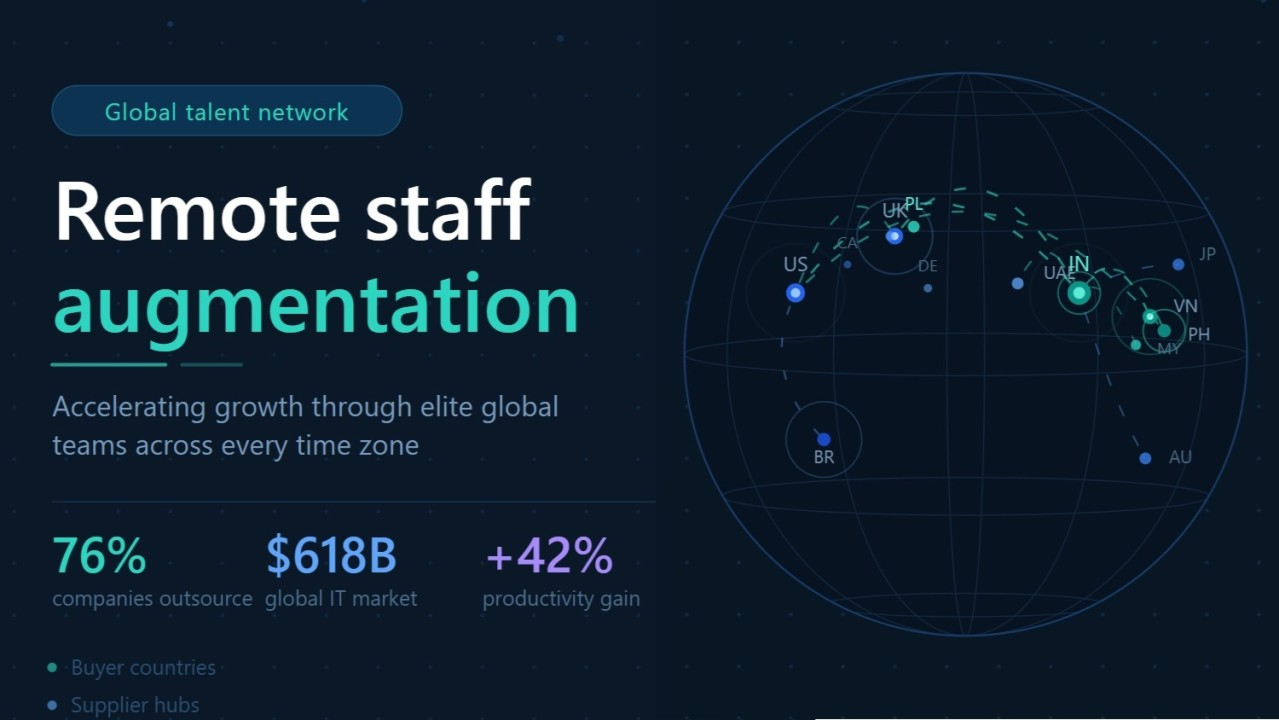
Remote Staff Augmentation Isn't a Cost Play, It's a "Competitive Weapon"
Staff augmentation is not a vendor relationship. At its best, it is a talent architecture decision, one that positions your company to move at the speed of ambition, not the speed of your local hiring market.
Why Mid and Large Companies That Still Treat Outsourcing as "Cheaper Labour" Are already Losing?
The conversation around remote staff augmentation has matured. In 2025, it is no longer a defensive cost-cutting move for companies facing budget pressure. It is an offensive growth strategy, one that the world's most competitive technology organizations use to ship faster, access scarcer talent, and scale without the friction of traditional hiring.
And the numbers back it up.
The global IT outsourcing market stands atUSD 618 billion in 2025, projected to hitUSD 732 billion by 2030(Mordor Intelligence). More telling: Deloitte's 2024 survey found thatmore than 76% of companies now outsource key technical tasks,from software engineering and QA to UI/UX design and AI development. This isn't a trend. This is the new operating model.
Why Remote Staff Augmentation Delivers Outsized Value
Let's be precise about what remote staff augmentation actually is. Unlike traditional outsourcing, where you hand a vendor an entire project and wait for delivery, staff augmentation means integrating global engineers, designers, data scientists, and architectsdirectly into your team. They work inside your sprints, under your product vision, aligned to your culture. You get the brain; you keep the wheel.
The value is real, measurable, and multi-dimensional.
1. You Unlock Talent That Doesn't Exist Locally
Every CTO in North America or Western Europe knows the pain: a senior ML engineer or a specialized cloud architect with deep Kubernetes-at-scale experience can takesix to twelve monthsto hire locally, if you find one at all. With staff augmentation, that same resource is accessible in days from Pakistan, Poland, or Vietnam.
Stanford University's research confirmed that remote workers are13% more productivethan their in-office counterparts, driven by fewer interruptions, no commute stress, and higher autonomy. That's not a marginal gain, that's one extra productive workday per week.
2. It Accelerates Delivery Velocity, Measurably
Speed is not a soft benefit. Companies using augmented global teams report compressing hiring-to-productivity timelines from months to weeks. The ability to field a fully operational engineering pod in a different time zone means your product doesn't sleep. While your core team closes their laptops in New York or London, a team in Bangalore or Kraków picks up the thread and advances it.
Remote work arrangements have been linked toproductivity gains of 42% higherat top-performing companies that embrace flexible, globally distributed teams (Fortune 100 Best Companies to Work For, 2025 data). That is not coincidence. It is architecture.
Cisco's collaboration research adds another data point: organizations that invest seriously in remote work infrastructure see31% higher productivityacross distributed teams. The infrastructure is the multiplier.
3. The Financial Case Is Overwhelming
Let's talk ROI. Organizations now spend an average of$1,800 per remote employee annuallyon collaboration technology, and that investment generates a280–420% ROIthrough increased productivity and eliminated office overhead (Second Talent, 2026 Remote Staffing Report). Globally, businesses saved an estimated$700 billion in 2024through remote and distributed workforce models.
The cost differential between hiring a senior developer in San Francisco (USD 180,000–220,000/year) versus an equally senior developer in Eastern Europe or Southeast Asia (USD 40,000–80,000/year, equivalent output, comparable technical depth) is not a rounding error. It is capital that funds product roadmaps, marketing, and market expansion.
4. It Enables Rapid Scaling Without Structural Risk
Mid-size companies between 200–2,000 employees face the most acute scaling tension: they have enterprise-level product ambitions but startup-level hiring budgets. Staff augmentation is a precision instrument for this problem. You scale a team for a sprint cycle or a product launch, then right-size it after. No severance. No restructuring. No year-long performance management processes. You maintain momentum, not headcount overhead.
5. Global Teams Build Better Products
Diversity of thought is not a DEI talking point when it comes to product development, it is a design principle. Engineers from different geographies bring different UX sensibilities, edge-case thinking, and problem-solving frameworks. Products built by globally distributed teams tend to be more robust and more globally relevant from the start.
The Critical Insight: Outsourcing Output and Tech Ecosystem Quality Are Positively Correlated
Here is what the data makes unmistakably clear:
The countries that have been the most active and sophisticated participants in global tech outsourcing, Pakistan, India, Poland, Ukraine, Vietnam, Brazil, Argentina, arealsothe countries building the most dynamic technology ecosystems of their own. This is not a coincidence.
Sustained outsourcing investment:
- Transfers institutional knowledge— engineering practices, project delivery methodologies, and quality standards from leading global companies flow into the local talent pool.
- Builds infrastructure— reliable internet, modern office stock, digital payment rails, and legal frameworks mature in response to enterprise demand.
- Creates capital formation— outsourcing revenues seed local angel investment, which seeds startups, which seed VC ecosystems.
- Deepens the talent pipeline— universities respond to market demand; engineering programs scale; boot camps proliferate.
Poland didn't produce globally competitive SaaS companies despite being an outsourcing hub. It produced thembecauseit was one.
What This Means for Your Company in 2027:
If you lead a mid or large company and you are not systematically leveraging remote staff augmentation, you are not saving money. You are leaving speed, talent, and competitive advantage on the table, and handing it to your competitors.
The strategic question is no longerwhetherto engage global talent. The question is how deliberately you do it.
The companies winning in 2026have moved from ad-hoc outsourcing to structured global talent strategy: defined partner geographies, clear roles for augmented versus core staff, robust async communication cultures, and intentional knowledge transfer practices that compound capability over time.
Staff augmentation is not a vendor relationship. At its best, it is atalent architecture decision,one that positions your company to move at the speed of ambition, not the speed of your local hiring market.
The world's top engineering talent is available. The infrastructure exists. The research is conclusive. The only variable left is organizational will.
The companies that move on this decisively will be the ones worth writing about five years from now.
AugmentAnywhere provides enterprise-grade global engineering capacity for organizations that need speed, specialization, and scale, without hiring constraints. It's not a marketplace. It offers you, your governed engineering partner.
Learn more at augmentanywhere.com or book a strategy call with our Tech Experts.
#RemoteWork #StaffAugmentation #TechStrategy #GlobalTalent #Outsourcing #ProductEngineering #DigitalTransformation #FutureOfWork #TechLeadership #Innovation