
The Smartest Hiring Decision U.S. Businesses Are Making Right Now, And Most Don't Even Call It Hiring
U.S. businesses are ditching slow, costly traditional hiring, and turning to remote staff augmentation to build elite engineering teams in days, not months. With the global market racing toward $857B by 2031, companies leveraging this model are cutting labor costs by up to 30% while accessing world-class talent in software engineering, AI, cybersecurity, and RPA, on demand, anywhere.
The Smartest Hiring Decision U.S. Businesses Are Making Right Now, And Most Don't Even Call It Hiring
The talent market is broken. Everyone knows it.
Senior software engineers in the U.S. are commanding $180,000–$220,000+ in base salary. A single cybersecurity architect can take 3–6 months to recruit. An AI/ML engineer? Good luck competing against Google, OpenAI, and Amazon for the same 500 people. And when you finally land someone, the average cost-per-hire is $4,700, before onboarding, ramp time, or the risk that they leave in 18 months.
There is a better model. It's growing fast. And the businesses using it are building engineering capacity in days, not quarters.
It's called Remote Staff Augmentation, and it's quietly becoming the dominant hiring strategy for forward-thinking U.S. enterprises.
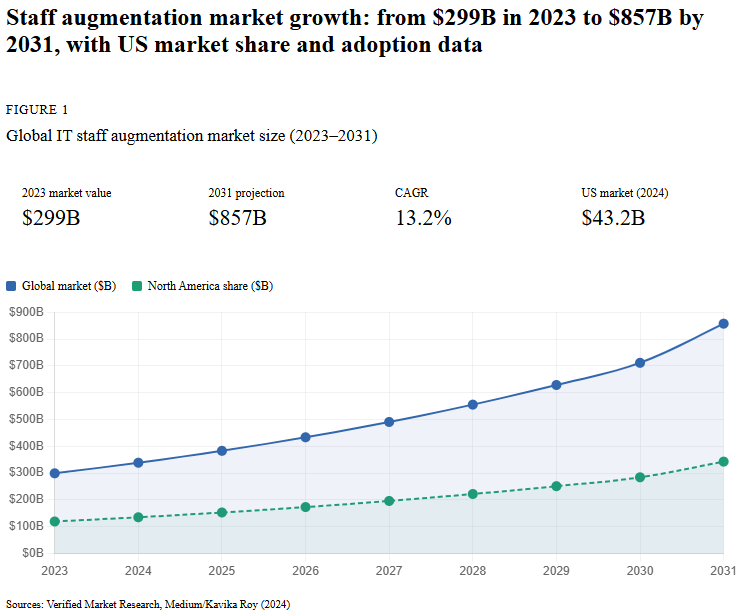
Figure 1 - Global IT Staff Augmentation Market Growth chart, market size from $299B (2023) to $857B (2031), North America share overlay
The global IT staff augmentation market was valued at $299.3 billion in 2023 and is projected to reach $857.2 billion by 2031, a compound annual growth rate of 13.2%. In the U.S. alone, the IT staffing industry reached $43.2 billion in 2024, growing at 7% year-over-year.
This isn't a niche play anymore. 74% of enterprises are now using staff augmentation services to overcome talent shortages. 70% of IT professionals work remotely at least part of the time. And North America holds the single largest share of this global market at 38–40%, driven by high digital maturity and an acute shortage of specialized engineers.
The World Economic Forum projected that 85 million jobs could go unfilled by 2025 due to a lack of skilled workers. That gap isn't closing, it's widening. And the companies that figure out how to access global talent pools aren't waiting for the domestic market to catch up.
Four Reasons Businesses Are Choosing Remote Augmentation Over Traditional Hiring
1. Speed to Deployment
Traditional hiring cycles for technical roles in the U.S. average 38 days — and that's before onboarding. Remote staff augmentation compresses that to days. Global talent pools with pre-vetted engineers, aligned to your tech stack and delivery standards, can be operational in under two weeks.
Deloitte's Global Outsourcing Survey found that companies accessing augmented teams decreased time-to-market by at least 30%. When product roadmaps don't pause for hiring timelines, the competitive advantage is measurable.
2. Cost Efficiency Without Compromise
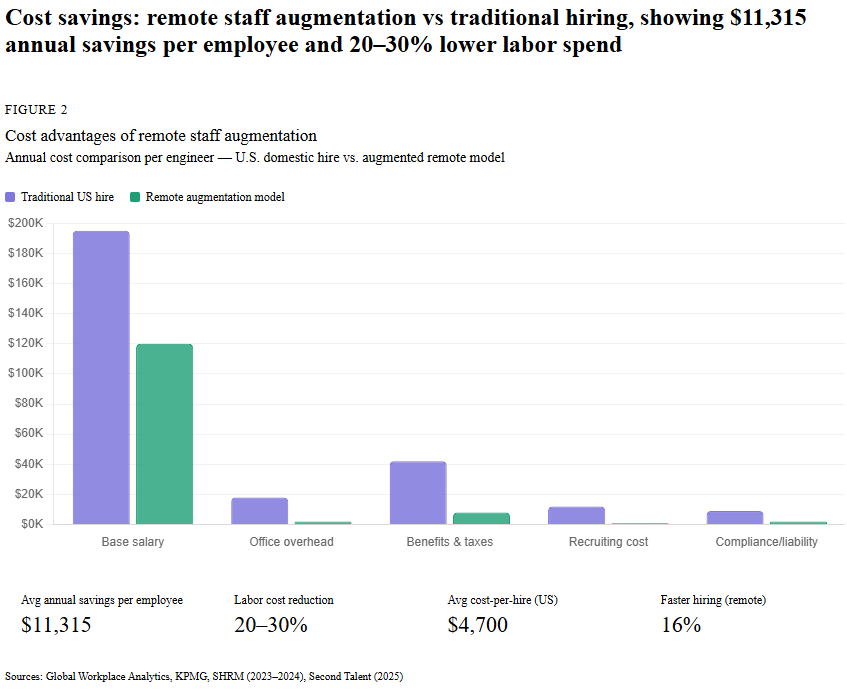
Cost comparison chart — Traditional US hire vs. remote augmentation model across salary, overhead, benefits, recruiting, and compliance.
U.S. employers save an average of $11,315 per year per remote worker through reduced overhead, office space, utilities, benefits infrastructure, and facilities management. Global Workplace Analytics estimated businesses saved $700 billion globally in 2024 through remote work alone.
When you move beyond remote-domestic to a governed global model, the labor cost arbitrage becomes even more significant. KPMG research shows that extending teams on a contract basis can lower labor spending by 20–30% compared to permanent hiring, without sacrificing quality when the right governance structures are in place.
3. Reduced Liability and Operational Risk
Full-time employment in the U.S. carries a significant compliance burden: payroll taxes, benefits administration, unemployment insurance, workers' compensation, severance obligations, and the ever-present litigation risk. Contract-based augmentation models, structured properly through a U.S.-registered entity, shift much of that liability while preserving the operational control that in-house teams require.
You get dedicated engineering capacity, full intellectual property protection, and the ability to scale teams up or down based on actual project demand, not headcount commitments made 12 months ago in an annual planning cycle.
4. Building a Genuine Global Distributed Culture
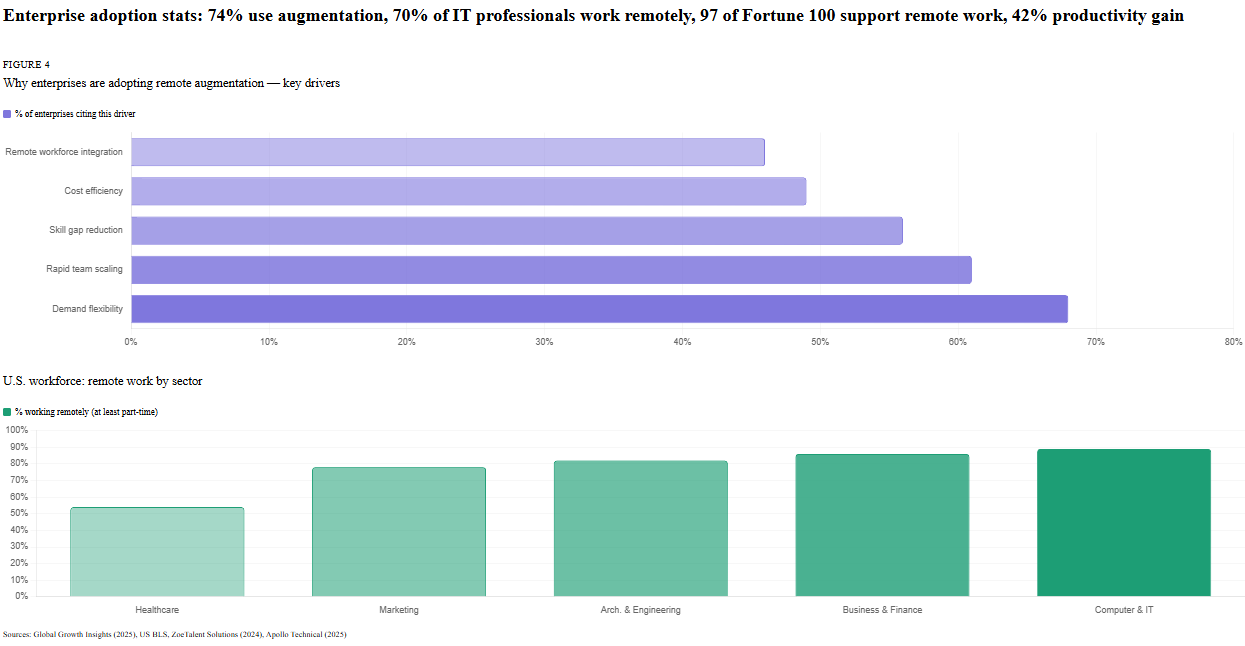
Figure: Enterprise adoption drivers + U.S. remote work by sector charts
The most durable competitive advantage of remote staff augmentation isn't cost or speed. It's access.
The U.S. simply does not have enough engineers. The Bureau of Labor Statistics forecasts a 25% rise in demand for software developers and QA testers by 2031, and a 35% increase for data-centric roles by 2030. Gartner projects a 22% surge in demand for AI and cybersecurity engineers alone. These roles cannot all be filled domestically.
Companies that build distributed engineering cultures — spanning multiple time zones, geographies, and talent ecosystems — don't just solve today's hiring problem. They build the organizational muscle for continuous execution regardless of local market conditions. 97 of the 2025 Fortune 100 Best Companies to Work For support remote or hybrid work, and their productivity levels are nearly 42% higher than typical U.S. workplaces.
Distributed teams, done right, are not a compromise. They are a structural advantage.
The Roles That Work Best Remotely, and Are in Highest Demand
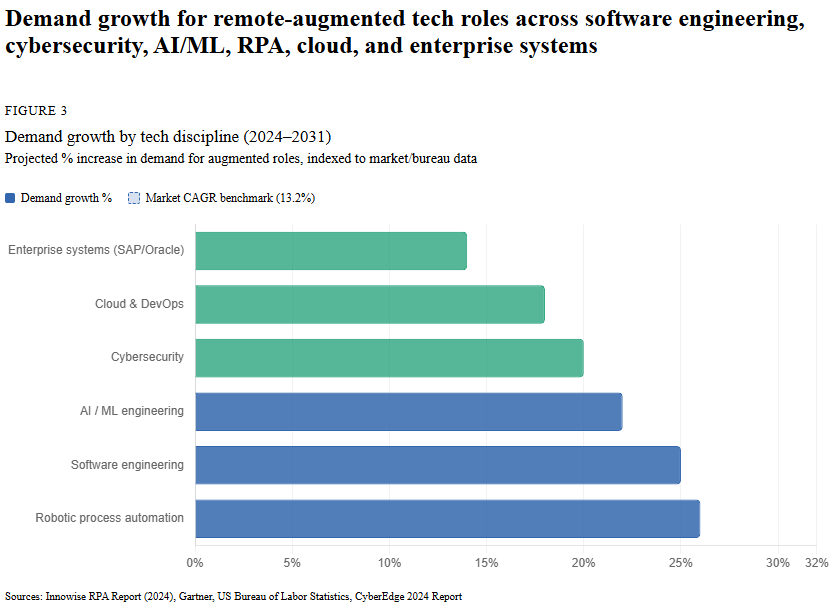
The data is clear: certain technical roles are purpose-built for remote augmentation. Here's where the demand is concentrated, and why.
Software Engineering
Full-stack developers, backend engineers, frontend specialists, mobile developers, API architects, and microservices engineers are the backbone of modern product delivery. Remote software engineering is the most mature segment of the augmentation market, frontend developers alone represented approximately $0.30 billion in market share in 2025. These roles require a laptop, a structured SDLC, and the right communication infrastructure. Geography is irrelevant.
Cybersecurity
This is the most acute talent shortage in enterprise technology today. 82% of CISOs in CyberEdge's 2024 Report increased their external security staffing in the past year. The global cybersecurity market is projected to reach $424.97 billion by 2030, but the talent to secure it simply doesn't exist in sufficient volume domestically. Security architects, penetration testers, compliance engineers, incident responders, and SOC analysts are being sourced globally through augmentation because there is no viable alternative at scale. Introducing dedicated security consultants through augmentation can decrease vulnerability exposure by 40%, according to the 2024 Accelerate State of DevOps report.
AI & Machine Learning
AI-powered systems are generating entirely new role categories: prompt engineers, data scientists, MLOps specialists, model governance leads, GenAI application developers, and machine learning infrastructure engineers. These roles didn't exist in meaningful volume five years ago. 33% of companies are actively planning AI integration right now, and the competition for qualified practitioners is intense. Staff augmentation gives enterprises access to specialists with real deployment experience, not candidates who've added "AI" to a LinkedIn profile.
Robotic Process Automation (RPA)
The global RPA market was valued at $22.79 billion in 2024 and is projected to reach $178.55 billion by 2033 at a 25.7% CAGR. 53% of organizations have already begun their RPA journey, with 78% planning to expand investments within three years. UiPath, Automation Anywhere, Blue Prism, and Power Automate implementations require specialized developers who are scarce and expensive domestically. Contract-based RPA engineers, embedded into your delivery teams, allow organizations to scale automation programs without the volatility of a permanent specialized hire in a fast-moving market.
Cloud & DevOps Engineering
Cloud migration, infrastructure automation, CI/CD pipeline design, and SRE practices require engineers who can operate across AWS, Azure, and GCP ecosystems. The cloud market is projected to reach $832.1 billion by 2025. DevOps automation specialists can cut deployment failure rates by up to 50%. These are high-leverage roles where a single strong engineer can unlock the capacity of an entire product team — and they are actively augmented by enterprises globally.
Enterprise Systems (SAP, Oracle, Microsoft, IBM)
SAP implementations, Oracle ERP migrations, Dynamics 365 rollouts, and IBM enterprise integrations are long-cycle, highly specialized engagements. The talent pool for these platforms is narrow, the rates are high, and the project windows don't justify permanent headcount. Augmented specialists, brought in for defined delivery phases, are how enterprises execute these programs without building permanent centers of cost around niche skills.
What Separates a Governed Augmentation Model from a Marketplace
Not all staff augmentation is equal. The difference between a talent marketplace and a governed engineering capacity model is the difference between a contractor and a co-pilot.
A governed model means your augmented engineers work inside your SDLC, your tools, and your governance framework from day one. It means role-based access controls, structured onboarding, documented access matrices, quarterly delivery reviews, and IP protection that holds up to enterprise procurement scrutiny. It means you contract with a U.S.-registered entity under U.S. law, with security controls aligned to SOC 2 and ISO 27001 frameworks.
The marketplace model delivers profiles. The governed model delivers outcomes.
The Hiring Model for the Next Decade
The companies winning the talent war in 2025 and beyond are not those with the biggest recruiting budgets. They are those that figured out how to access the global engineering talent pool, systematically, securely, and without the overhead of building it all in-house.
Remote staff augmentation, at its best, is not a workaround. It is a deliberate architecture: a distributed, specialized, scalable engineering capacity that responds to business demand instead of constraining it.
The market has spoken. The model works. The question is whether your organization is using it.
AugmentAnywhere provides enterprise-grade global engineering capacity for organizations that need speed, specialization, and scale, without hiring constraints. It's not a marketplace. It offers you, your governed engineering partner.
Learn more at augmentanywhere.com or book a strategy call with our Tech Experts.
#StaffAugmentation #EngineeringCapacity #RemoteWork #TechTalent #DigitalTransformation #SoftwareEngineering #Cybersecurity #AIEngineering #RPA #EnterpriseIT #FutureOfWork #AugmentAnywhere